Here at 36C3 congress the "bla.local" bonjour stuff doesn't work. Incase you see 127.0.1.1 as the IP, you have to edit that out in the following file:
sudo nano /etc/hosts
| 2026 | 2024 | 2023 | 2022 | 2021 | 2020 | 2019 | 2018 | 2017 | 2016 | 2015 | 2014 |
|---|---|---|---|---|---|---|---|---|---|---|---|
| 2 | 2 | 11 | 15 | 23 | 13 | 30 | 72 | 152 | 102 | 134 | 62 |
Here at 36C3 congress the "bla.local" bonjour stuff doesn't work. Incase you see 127.0.1.1 as the IP, you have to edit that out in the following file:
sudo nano /etc/hosts
So this took me a while. The library that I'm using stores the matrix data in a one dimensional array with the length of 40 * 16.
Each LED matrix is 8x8 and are connected in that order:
0 - 1 - 2 - 3 - 4
                |
9 - 8 - 7 - 6 - 5
And each LED matrix is wired like this:
0 - 1 - 2 - 3 - 4 - 5 - 6 - 7
8 - 9 - . . . . . . . . . . .
. . . . . . . . . . . . . . .
. . . . . . . . . . . . .  63
When I finally found the error in this function, I had already written a lookup table for all the 640 LEDs. This is fixed for my setup, but it should be possible to rearrange it for others.
int matrix_arrangement[] = { 0,1,2,3,4,9,8,7,6,5 };
void club_matrix_render(void)
{
    for (int i=0; i<led_count; i++)
    {
        int led_real_x = i % width; // 0 to 39
        int led_real_y = i / width; // 0 to 1

        int matrix_number_x = led_real_x / 8; // should be 0 to 4
        int matrix_number_y = led_real_y / 8; // should be 0 or 1

        int matrix_number = matrix_number_y * 5 + matrix_number_x; // 0 to 9

        int matrix_x = led_real_x % 8; // 0 to 7
        int matrix_y = led_real_y % 8; // 0 to 7

        ledstring.channel[0].leds[matrix_arrangement[matrix_number] * 64 + matrix_y * 8 + matrix_x] = matrix[i];
    }
}
Finally decided on soldering a PCB and when I programmed it, it wouldn't start the program afterwards. So I was calling for help on twitter and got some well meant advices about pulling certain pins that no ESP32 dev board pulled up. It took me a while to notice that I was missing the capacitor in my reset circuit. I didn't check what C6 actually does while debugging, so I thought being so close to the ESP reset pin and resistor, that it was part of it. With a bodged on capacitor it now resets to run the program!
So far it's only a cartridge shaped ESP dev board that can talk to 5V devices, but it's good to know this is programmable!

Getting stuff done when you're watching your niece and changing diapers isn't an optimal combination! But I managed to write a little library that handles the display driving etc. So now I have to reprogram everything I had running before, like the enemies that are moving and drawing to the frame that then get's shown.
The title says it pretty much, but I had some trouble getting somewhat reasonable priced IS31FL3731 in SSO, while you can get the QFN version just anywhere. My current BOM for one donut is around 7 Euros now, which still seems reasonable. 800 LEDs in 0603 are coming my way, too. Hundreds of red, yellow, orange, green, blue, white, pink and purple.
So I've made this thing for element14 presents, never really had a set and forget PI to work on. I do like the optics of the SX-64 very much and all the other "portables" from the 80ies. I went with makerbeams 10x10mm aluminium extrusions for the frame and some lasercut MDF to hold everything together. Still needs an enclosure, but I'm pretty happy with it.
I tried to make the 2K display work, but it was too flickery and I couldn't get it to work properly, so I switched to the official display.
https://github.com/pjimenezmateo/kindle-wallpaper/blob/master/In%20the%20Kindle/launch.sh
Type in homescreen, without USB connected:
;debugOn
~usbNetwork
and then plug in USB cable
PI of kindle: 192.168.15.244
Password: mario
mntroot rw
nano /etc/crontab/root
I've chosen to go with JLCPCB and order 5 white test boards and a bunch of LEDs.


When I was talking with people about how some badges use two pins of the attiny, I basically explained it to myself while trying to explain to others why it would be louder. Instead of just pushing the speaker from the resting position, you also pull it back, when connecting both the inverted oscillator pins to a speaker. Now at the airport and thanks to seeing Charles Lohr at the supercon, I remembered that he actually did that. I need to further hack that bodged prototype I guess :D
Friday night at supercon I decided to spend some time on the I2C part of the firmware. It's pretty simple, but I'm now able to send data from the #Penghicorn badge to this SAO and it will play a tone. Of course this can be further expanded, but I'm quite happy with the beeps. The speaker is very quite though and I need to take a look at other preferably surface mount speakers. Someone made a beeping R2D2 SAO and that has a nice speaker I want to check out.

I still need to make this work / compile with all the feathers, sounds like a good software project for my vacation, right? The PCB could get got an update too, all 8 inputs and 8 outputs on a header.
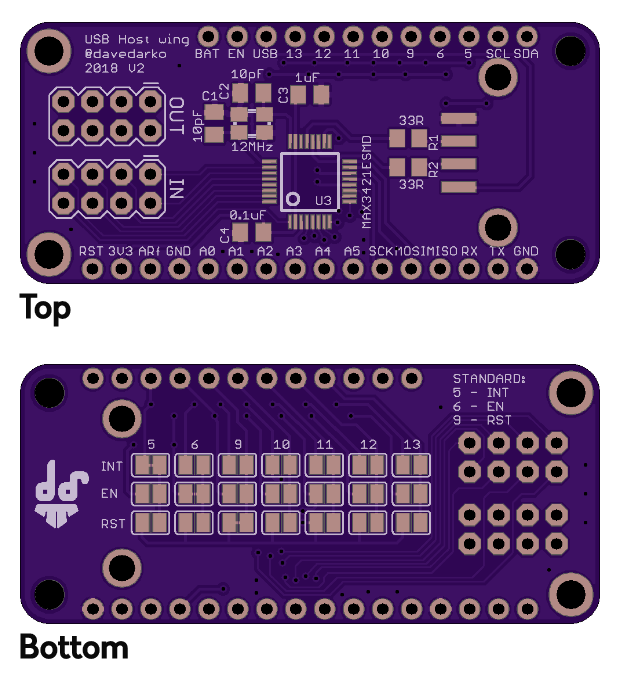
always wanted to do this, but it needed a tindie message to force me to finally draw this.


Two out of three solenoids are "burned" / jammed at this point. When I was cutting the switch connectors off of the locks, I didn't check the wiring. Some of the connectors had switched red and black wiring. I first thought my 700mA was not big enough, but it died regularly when two coils where powered at the same time.
Now I only have a problem where my signals aren't strong enough every 9/10 times. Two times out of those it will recognise something, but then the checksum must be bad as it doesn't do what it was told.
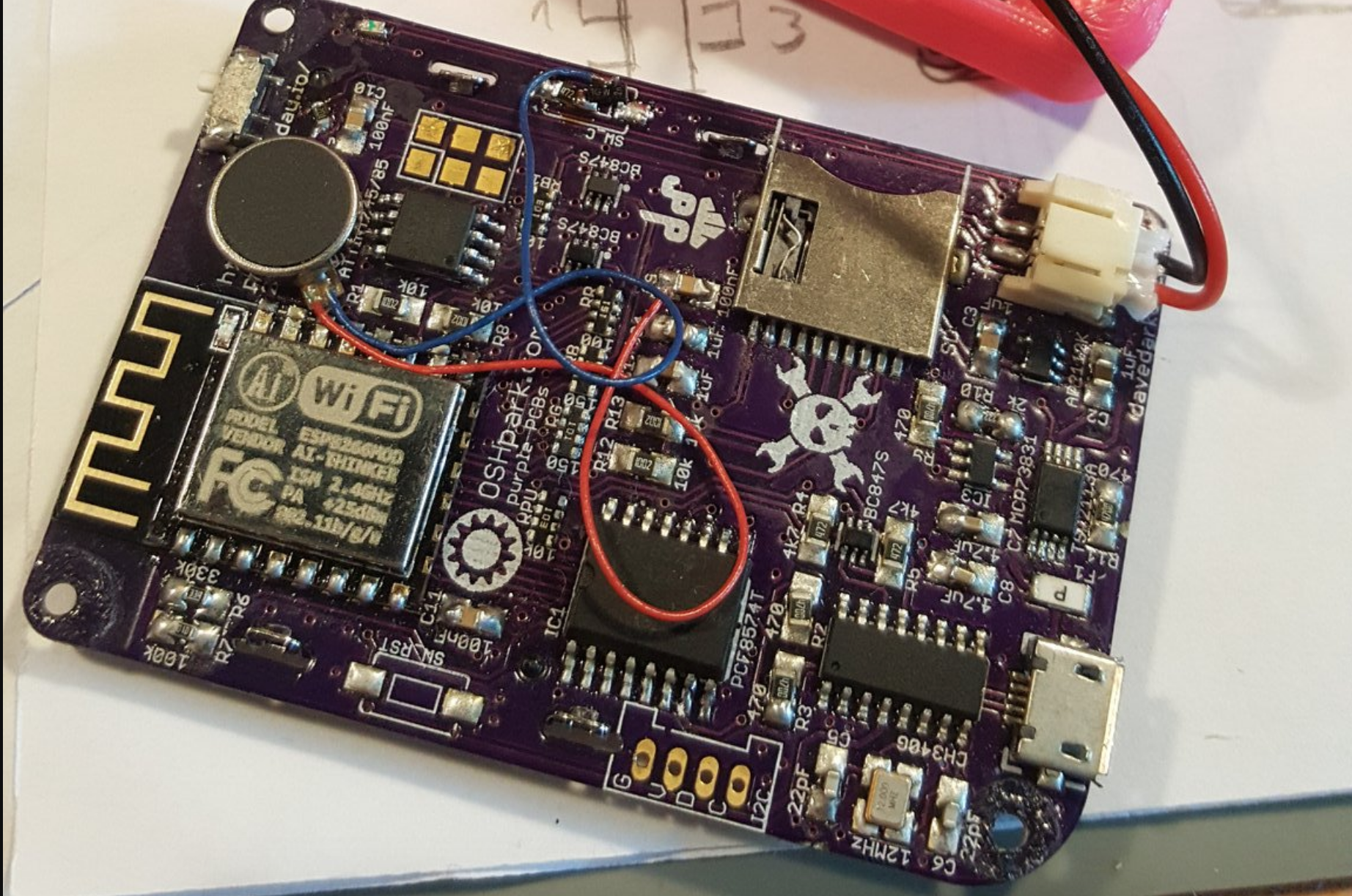
Not yet sure how important that is, but I found a 4k7 pulldown resistor on the A+ connection of the relay board. The 4k7 resistor connected to B- leads to nothing an unpopulated resistor footprint. The chip itself seems to be a MAX485.
Biasing and termination resistors in a story factor with oscilloscope pictures:
 |
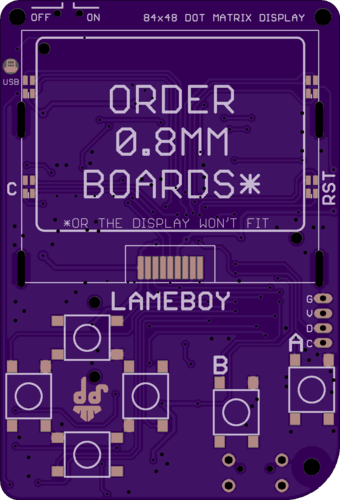 |
Added minimal changes overall, but they are quite a decent change functionality wise. When woody added a pager [here], I was amazed by the idea. When I saw him and his Lameboy the other day at the 3rd Hardware Happy Hour in Berlin, I decided to add that to one of my own and add an update to the schematics.
Much often I forget to add sound to my projects and here I try to free GPIO0 from resetting the LCD and instead connect a tiny buzzer to it. The LCD has a reset circuit added now.
I'm undecided to wheather I should order these versions or mod the other 10+ pcbs though, so I'll just update the github repo for now.
For the first new video I've finally worked some more on my R2-D2 vs. Johnny V mash up robot. You know, the one where I was too lazy to work on both, so I've joined them together :D Anyway, the matrix voice kit was a bit frustrating and I was all over the place with what I wanted to do with this robot, it probably shows.
The second video is an LED matrix that takes midi inputs or listens with a microphone. Inspired by close encounters of the third kind, of course! This video was so much more fun to make then the matrix voice robot. Finally a video where I was certain enough, that a bit of "regrettable acting" wouldn't hurt this time.
Third and most recent video, is a 3D printed Iron Man helmet with a head up display! I'm using two RGB 160x80 OLED displays and some cardboard lenses to show data I gathered from a BMP280 humidity sensor and an MPU9250 magnetometer.
Just in case I need to scale this up and ever get to the point where I consider a PCBA service:
here are the LEDs I would probably want to use instead: LG T770, LY T77K, LP T770, LW T773, LG T770, LO T77K, LY T77K - well some of them.
this might be continued.
For this year's MakerFaire in Berlin @Alex,
@bitluni,
@Clemens Mayer and I formed a collective called "⅘ Sterne". Everything that happened, everyone I've met and everything I have seen, wouldn't fit in a single tweet, so I thought I would write a
bit.
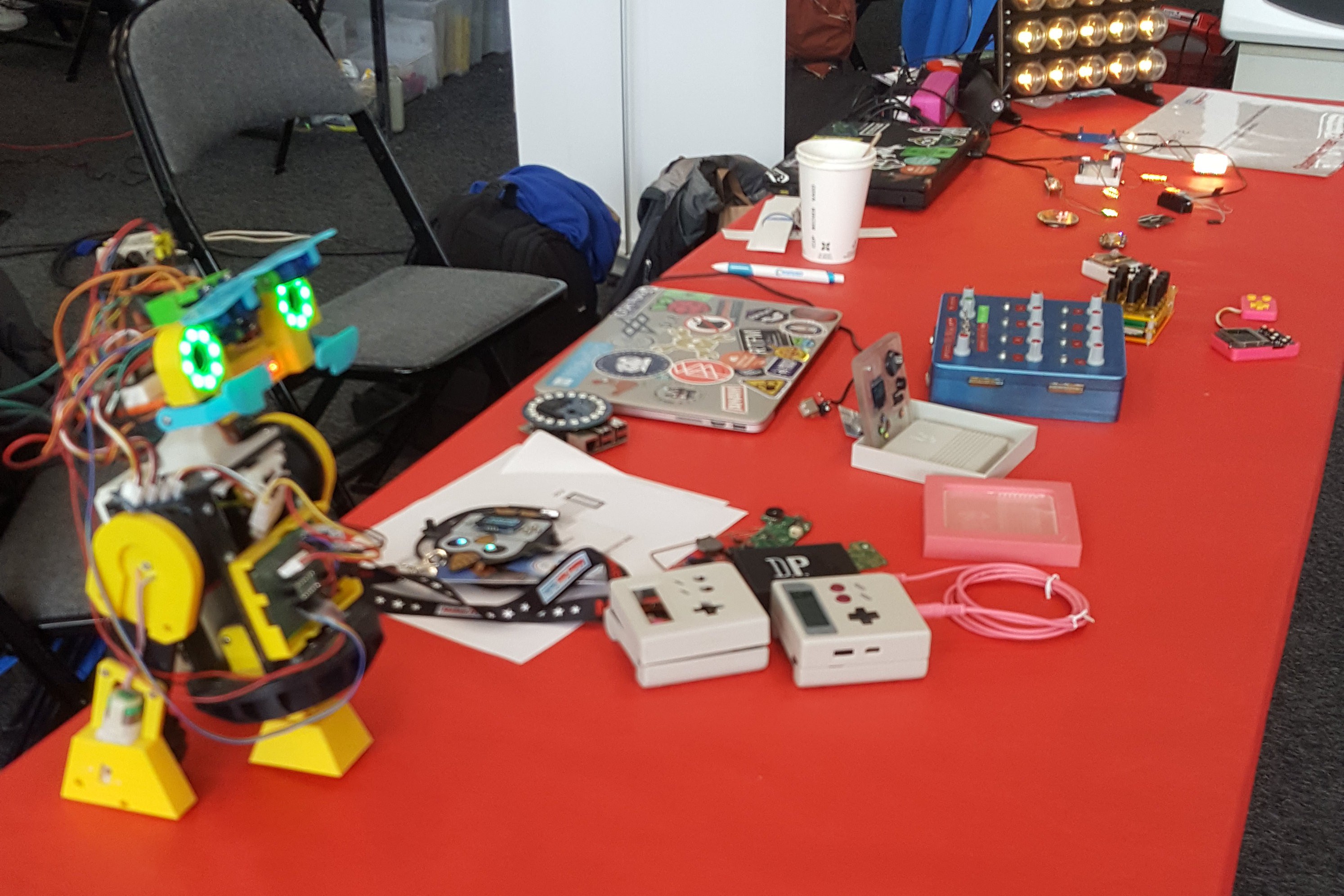
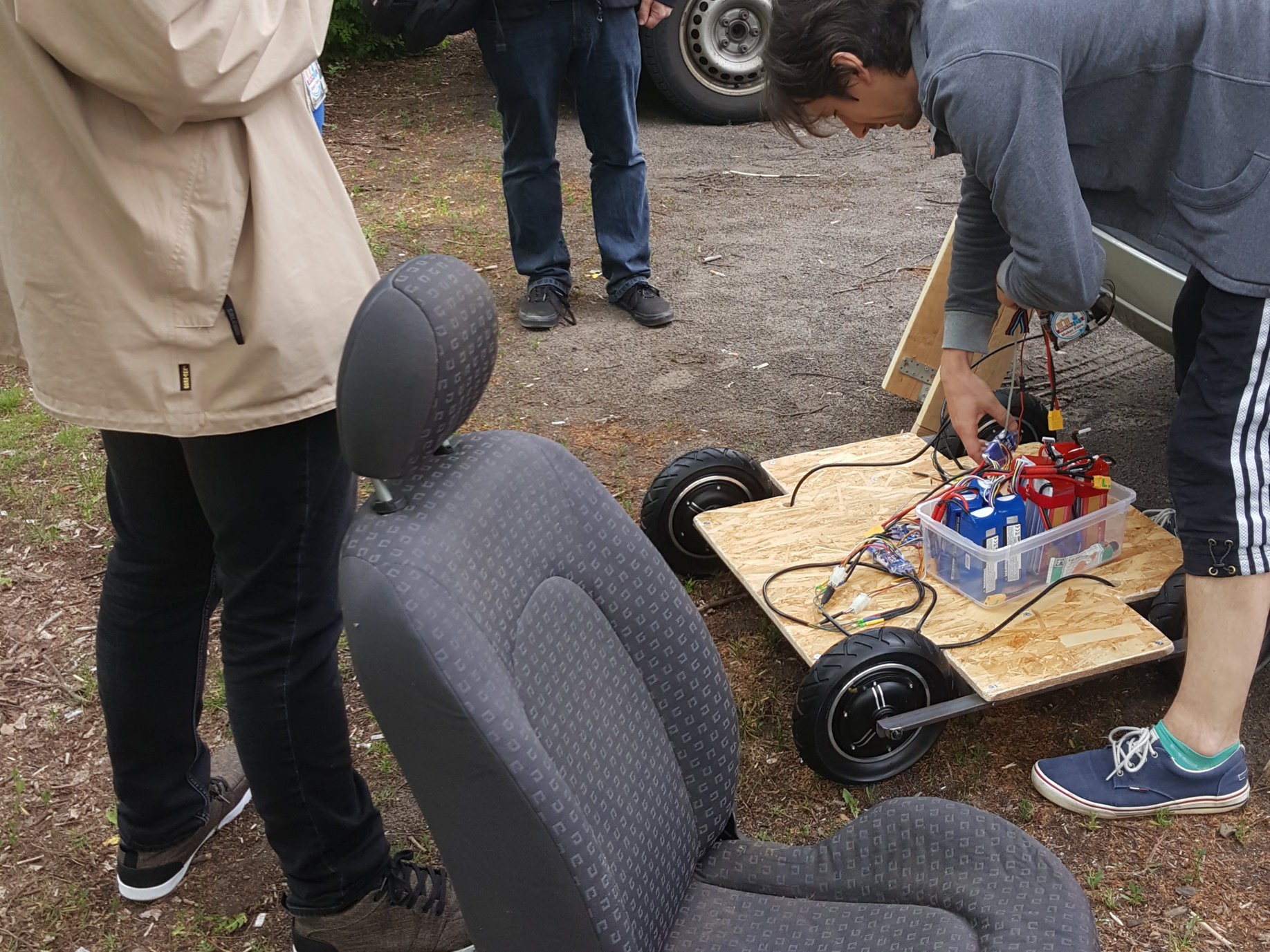
Setting up started on Thursday, since the next day the MakerFaire would be open to school classes. Clemens wouldn't take any projects with him on the plane and Alex's projects are - well - tiny - so I had the two tables to my self on Friday. With a red paper table cloth and yellow tape that would only be enough for 80% of a 4/5 Stars "tape art" logo. Fitting. It was my first "school day" and I noticed: those days are weird. Kids come with a totally different expectation than on the regular days. They come to be entertained and expect you to have games prepared. Luckily Bitluni arrived with a new top secret project, that we took for a test run on the parking lot.
On Saturday Bitluni was assembling his projects from the beginning of the opening. He quickly ran out of table space, even though we sneakily moved a table from our no-show neighbours. At one point I yelled "Promise me this is the last project!". We were looking forward to meet people from "all over the world", who announced that they would come. One of them was @deshipu - he didn't get a table but we were more than happy to share table space, so he could show his Tote and Pew Pews. The mighty @Stefan Kremser joined the booth for a bit, I handed him back some Game Boy mainboards that he was so kind to lend me for a video.
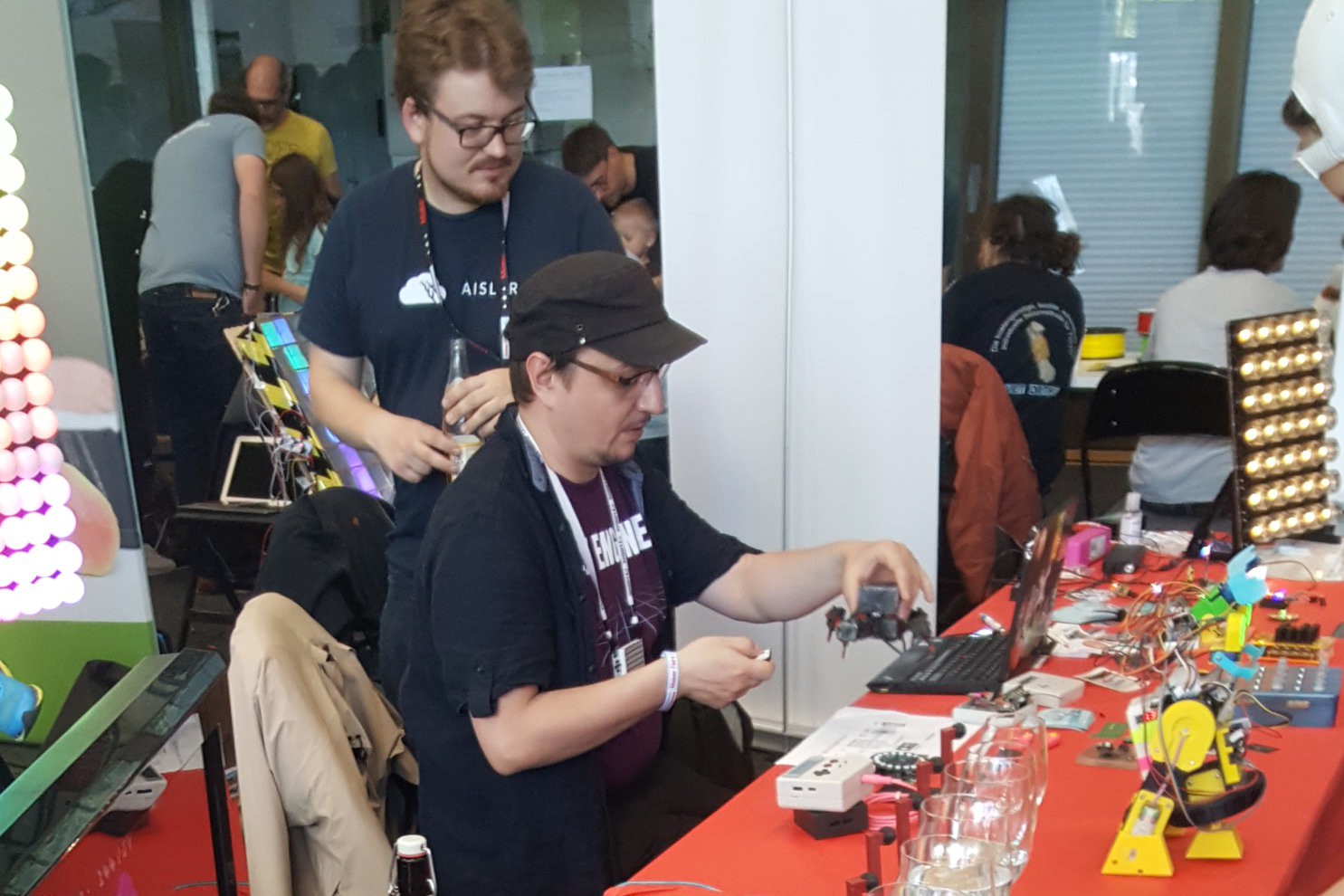
I was happy to see my Cousin and his son and also a friend from school I haven't seen in ages. And then there was "Great Scott" and yes, "Senpai noticed me!", because he knew me from my element14 videos :3 From the first "Hardware Happy Hour" I've seen three people (that I remembered at least). People that I only knew from twitter before where - not just Arturo182. But we were happy to drink beer with him in the afternoon, to the sweet live music by wu-tang clan and public enemy - they were playing live, very very close.
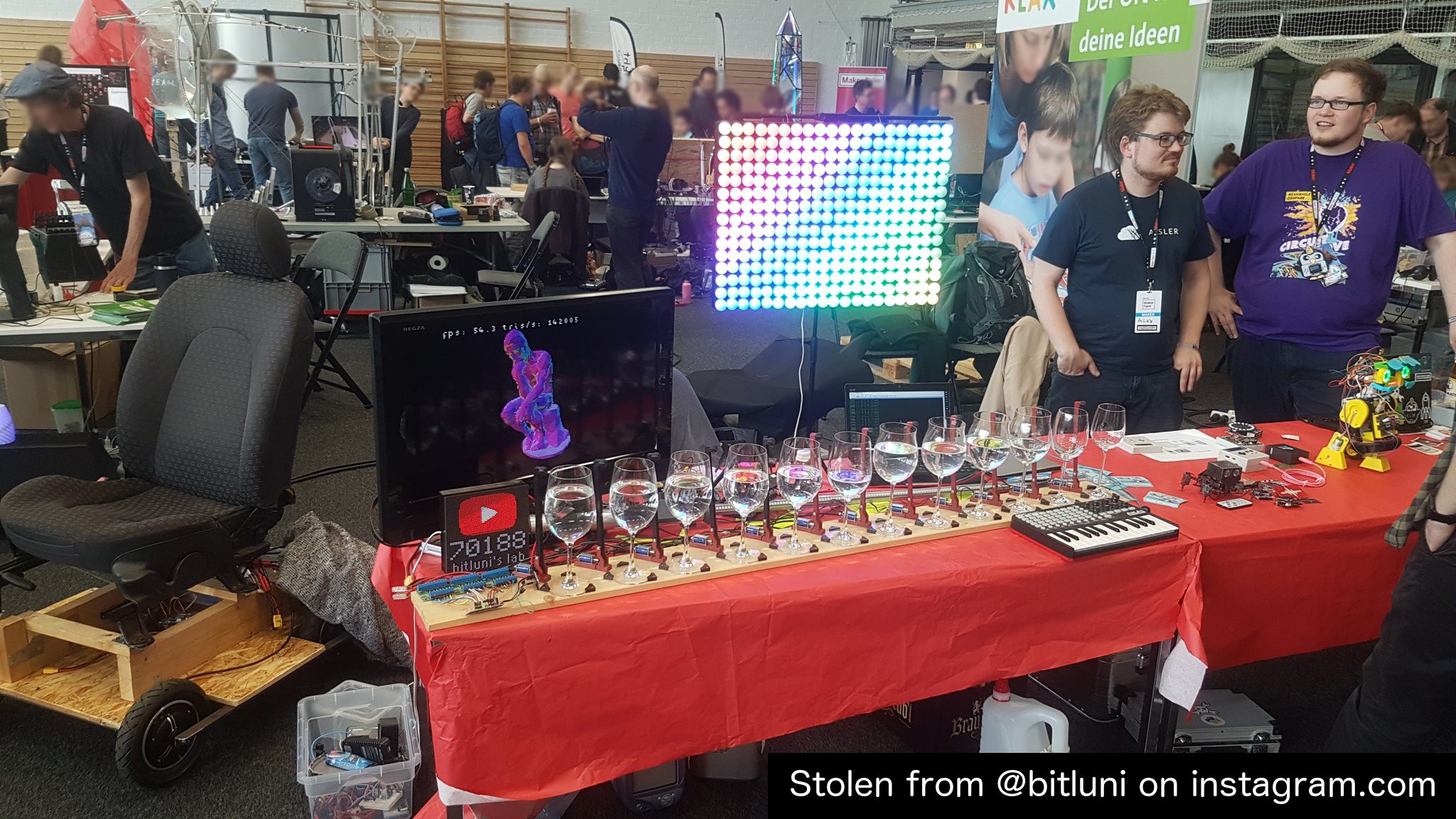
we declared @arturo182 as our fifth member on Sunday, by handing him the spare MakerFaire badge and I think he enjoyed his Berlin MakerFaire experience. There was a Mexican family with maker kids, who call themselves "moon makers" ( https://www.instagram.com/p/BxsArl_pJf4/ ) and they've interviewed me for a bit. Made me happy to see how both are interested in the making scene! For element14 I'm currently working on a video for the Matrix Voice hat and by coincidence was running into a developer. I'm also pretty sure he used a selfie to escape my questions.
As always we noticed we weren't prepared enough, really need a lot more info material / handouts to not always tell the same things. At this point it seems like we can try this again very soon in August, for the MakerFaire in Hannover. I had a lot of fun, it was also exhausting and I would have enjoyed more time with the gang to actually build something. Thank you to everyone I've met, that helped, visited etc. and sorry to the Danish guy that told me a brief excerpt of his very fascinating life story - you were always very busy when I was close to your booth to say hi again!
My favorite moments where when kids were happy about my R8-J4 robot driving towards them, even though it was basically a cheap trick and I want the robot to do so much more. But also whenever I was talking about my Game Boy music player, I saw my excitement pass on to the people I was telling them about.
--
Totally forgot Spencer from "RFC2795 Ltd" [https://www.tindie.com/stores/Semachthemonkey/] and Robert from "part fusion electronics" [https://www.tindie.com/stores/PartFusion/], fellow tindie sellers - they had a booth too and we drank some beers, was fun to meet them! Robert brought a huge LED that you can see here: https://twitter.com/arturo182/status/1129809267765207041
It's basically a NeoPixel ring and an FPGA that handles 8 I2S microphones, plus some GPIOs and an optional ESP32 that can make the hat work stand-alone - but you still need a Raspberry PI to program it. Via SSH over another computer.
It's a BlinkenLights microphone.
It only get's interesting when you combine it with voice recognition software, granted the examples also work with a USB microphone connected to the Raspberry PI.
First I tried to get the wakeword example from their "matrix core" library to work, but seemed to have failed at setting up the Sphinx Knowledge Base. It triggered very randomly and never did I see a word that I had said, even if I said the word that supposedly triggered before that.
The second offline voice recognition software that I've tested is "porcupine" by picovoice and their speech-to-intent engine called "rhino" - pretty impressive stuff, but their context demos are for a coffee-machine, a music player _or_ a light switch. Nothing interesting for a robot.
Tomorrow I will "play" with the snips platform, as someone on twitter suggested.
Setting up a headless Raspberry PI A+ first.
I've filmed two videos for element14 now, and I feel like I should promote this here. You don't have to watch it or click on it, I just wanted to get the word out some more. I will bring both projects with me to the MakerFaire Berlin from the 18th to 19th of May. We will have a booth there, that's me, @Alex , @bitluni and @Clemens Mayer!
I might have talked about this somewhere already, but here's my original hardware, portable music player. They call it "Gameboy Walkman", I call it DMG player.
This video shows my 2nd version of the #Skeleton Attiny85 Handheld - before the resin.
And here I am putting it in resin, like so many in the comments wanted me to do.